
- "No experience" really means "no proof yet" — so create the proof.
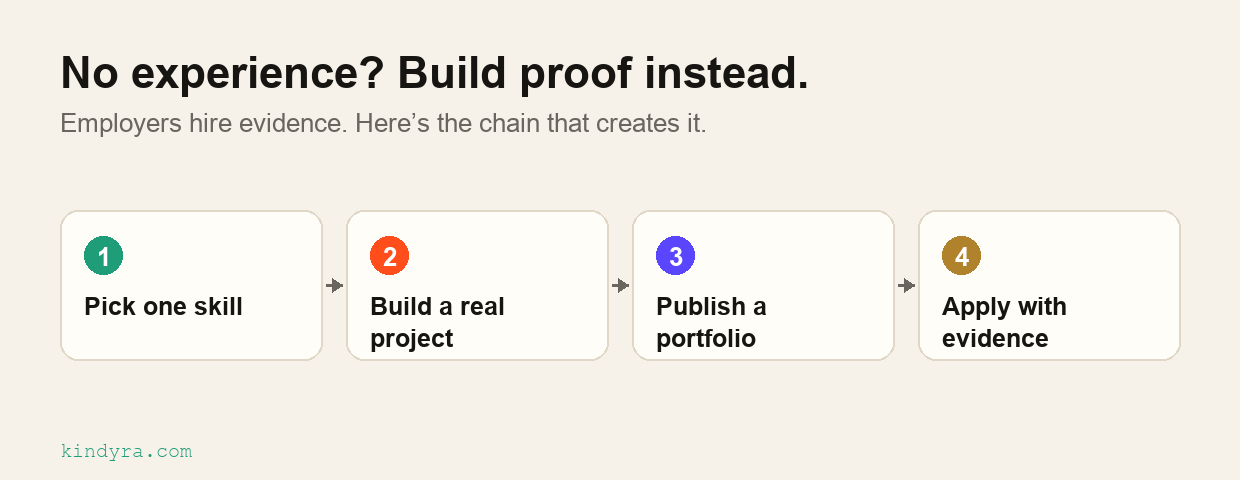
- Pick one in-demand skill and finish one real project in a 30-day sprint.
- A project you can explain beats a stack of certificates.
The frustrating loop — you need experience to get hired, but need to be hired to get experience — breaks the moment you stop waiting for permission and start creating proof. You can manufacture evidence of ability on your own.
Why "no experience" is really "no proof yet"
Employers aren't literally demanding years — they're trying to reduce risk. They want confidence that you can do the work. "Experience" is just the usual proxy for that confidence. If you can supply the confidence directly — through visible proof — you sidestep the requirement.
That reframes your whole job: you're not accumulating years, you're accumulating evidence.
Pick one skill, not five
Spreading yourself across many skills produces shallow ability in all of them. Pick one skill with clear demand and clear ways to demonstrate it — writing, design, data, a coding stack, a trade skill. Depth in one is far more hireable than a scatter of half-skills.
Build in public, in small sprints
Learn by shipping small things on a schedule. A 30-day sprint of bite-sized daily challenges works because each day ends in something concrete instead of vague "studying."
- Days 1–7: learn the fundamentals; complete tiny exercises.
- Days 8–21: build one real project, start to finish.
- Days 22–30: polish it, write up what you did, and package it as a portfolio piece.
At the end you don't just "know" the skill — you have a finished thing that proves it.
Turn practice into proof employers trust
Proof beats claims every time. The strongest kinds:
- A portfolio piece or case study showing your process, not just the result.
- A real (even unpaid or personal) project solving an actual problem.
- A short write-up of what you built and what you learned.
One genuine project you can walk someone through is worth more than a stack of certificates you can't discuss.
Five starter projects that count as proof
Stuck on what to build? Each of these fits inside a 30-day sprint, ends in something a stranger can look at, and has an obvious home online. Pick the one that matches the skill you chose — and finish it before you start a second.
Coding: a small tool that fixes one real annoyance
A budget tracker, a booking form that checks its own inputs, a script that renames a messy photo folder. It proves you can go from a blank file to a working result. Where to publish: the code on GitHub with a README — what it does, how to run it, what you would improve — plus a live link if it runs in a browser.
Data: a one-page analysis of public data
Pick an open dataset — your city's transport or housing data, a sports season, a public survey — and answer one question with three charts and a written conclusion. It proves you can find a signal and explain it plainly. Where to publish: a PDF or notebook in a public repository, with the headline finding in one sentence on your resume.
Design: a redesign of one screen you use every day
Take one screen from an app you actually use, show the before and after, and write a paragraph per change explaining why it helps the user. It proves you think about people, not just pixels. Where to publish: a case study on a portfolio site or a design community, and a one-image summary on LinkedIn.
Writing or marketing: a sample campaign for a real local organization
Offer a community group, small business or school club three social posts, one email and a landing-page draft. It proves you can write for an audience and a goal. Where to publish: a short case study with the brief, the work and — if they let you run it — what happened.
Operations, admin or support: a documented process
Turn something messy — volunteer onboarding, a shared inbox, event sign-ups — into a checklist, a tracker and a two-page how-to. It proves you can bring order and communicate clearly. Where to publish: a shared document or spreadsheet you can link to, plus a before/after paragraph.
Whichever you pick, write the same four-line summary when you finish — the problem, what you did, the result, what you would do next — and put the link under a Projects heading on your resume, above Education if you have no relevant work history. Kindyra Resume's resume with no experience page shows where that section goes, and our guide to building a portfolio covers how to present more than one.
Then let the proof do the talking
With a project in hand, your resume changes tone — from "seeking an opportunity to learn" to "here's what I built." That's the sentence that gets interviews.
Frequently asked questions
How do I get experience with no experience?
Create it. Build a personal or volunteer project that solves a real problem, document your process, and present it as proof. Self-initiated work counts as evidence of ability.
Are certificates enough to get hired?
On their own, rarely. Certificates show you studied; projects show you can do. Pair a certificate with one finished project you can explain in an interview.
How long does it take to build a job-ready skill?
A skill sprint is designed to take about 30 days at 30–45 minutes a day — enough time to learn one skill and finish one small project you can show. That project becomes the proof you apply with.