
- 30 days won't complete a career change — but a daily sprint is designed to build real momentum.
- Pick one direction, learn one skill, and create one piece of proof.
- Finish the month applying with evidence, not guesswork.
Thirty days won't hand you a new career overnight — but a sprint of 30–45 minutes a day is designed to leave you with one skill learned, one small project you can show, and the momentum to walk into applications with evidence instead of guesswork.
Can you really change careers in 30 days?
Honest answer: not completely — but you can start convincingly. A full career change is a season of your life, not a month. What 30 days can do is get you from "I'm thinking about it" to "I've learned something, built something, and I'm applying." That shift is the hard part, and it's what these four weeks are designed for.
The trick is to stop treating a career change as one giant leap and break it into small, daily actions that compound. Kindyra is built around exactly this: learn, build proof, prepare your resume, apply.
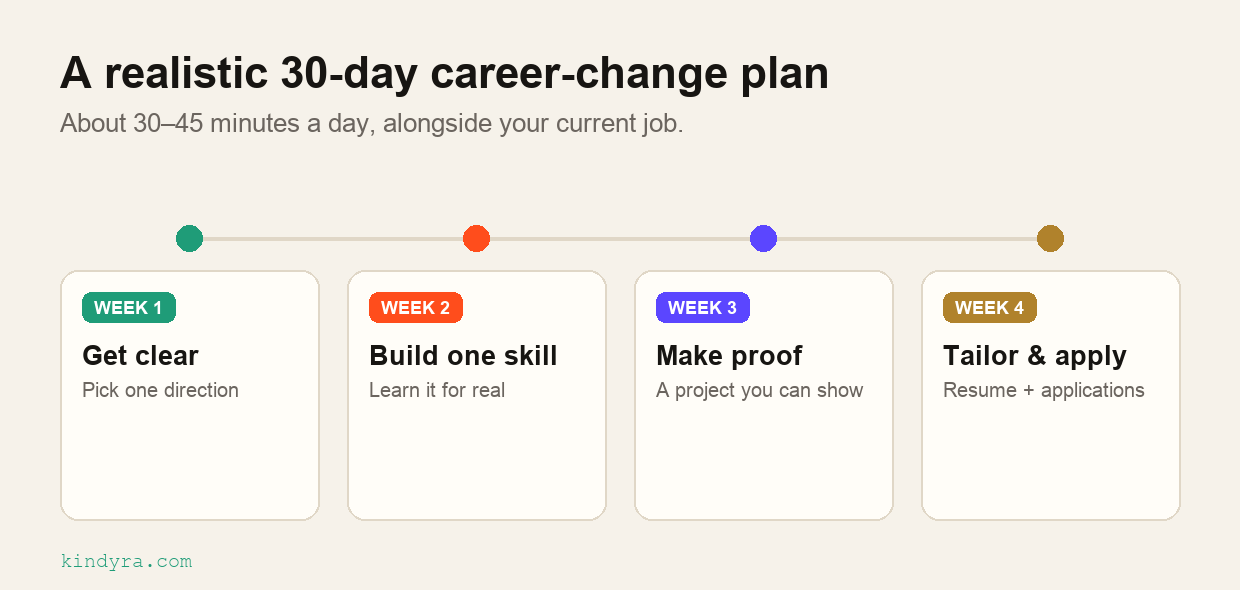
Week 1 — Get clear and pick one direction
Spend the first week narrowing, not exploring. Trying to keep five options open is why many career changes stall. Pick one target role or field to test for the month. Not sure which? The free career quiz helps you narrow it to one. You can always pivot later.
Write down three things: the role you're aiming at, one skill it clearly requires, and one type of proof employers in that field respect (a portfolio piece, a certificate, a sample). That's your whole plan.
If a new language is part of your goal — relocating, client-facing work, or standing out — this is the week to start daily practice while it's still fresh and motivating.
Week 2 — Learn one skill by building
This is the core of the month. Choose one in-demand skill and work at it a little every day rather than cramming on weekends. Consistency beats intensity for skill-building.
Structure helps enormously here. Instead of drifting through random tutorials, follow a focused daily plan with small challenges that end in something you actually made. A Kindyra Skill Sprint is built this way: a skill sprint is designed to take about 30 days at 30–45 minutes a day — enough time to learn one skill and finish one small project you can show. In this plan, week 2 is the learning stretch and week 3 is the building stretch.
- Aim for 30–45 focused minutes a day.
- Finish today's exercise before reading ahead — small finished things beat big half-finished ones.
- Save every piece of work in one folder. It's the raw material for next week.
Week 3 — Turn the skill into proof you can show
Knowing a skill and being able to show it are different things, and only the second one gets you interviews. Spend week three on one small, finished project that looks like the work you want to be paid for. "Finished" matters more than "impressive": a complete small thing with a short write-up beats an ambitious half-built one every time.
What counts as proof depends on the field. These are illustrative examples, not the only options:
| Target field | A week-3 proof project | Where it lives |
|---|---|---|
| Coding / web | A small working app or page that solves one real problem — a booking form that checks its own inputs, a budget tracker, a tool for a hobby. | Code on GitHub with a README, plus a live link. |
| Data / analysis | A one-page analysis of a public dataset — your city's open data, for example — with three charts and one clear conclusion. | A shareable PDF or notebook, linked from your resume. |
| Design | A redesign of one screen of an app you use, with before/after and a paragraph on why each change helps the user. | A case study on a portfolio site or a design community. |
| Marketing / content | A sample campaign for a real local business or community group: three posts, one email, one landing-page draft. | A short case study — better still, results if they let you run it. |
| Operations / admin / support | A documented process — an onboarding checklist, a set of help-center articles, a tracker — built for a volunteer group or your current team. | A shared document or spreadsheet you can link to. |
| A new language | A recorded two-minute self-introduction and a short written piece at your honest level. | A private video link, plus an honest level on your resume. |
Whatever the field, end the week with a half-page write-up: the problem, what you did, the result, and what you would improve next. That write-up becomes your interview story — see how to explain having no experience in an interview. For more ideas on presenting the work, our guide to building a portfolio goes deeper.
Week 4 — Turn progress into a resume and apply
By week four you have something many career-changers never get: evidence. Now package it. Rewrite your resume around your new direction — lead with the skill you built and the proof you created, not just your old job titles.
Make sure it's ATS-friendly (clean formatting, real keywords from the job description) so it survives the automated screen. Then apply to a small, targeted batch — quality over volume — and reuse your project as a talking point.
Your day-30 checklist
If you can tick every line below, the month did its job — whether or not an offer has arrived yet.
- One target role written down, with the one skill it needs.
- A daily habit you kept most days — not perfectly, but most days.
- One small, finished project you can open on a screen in an interview.
- A half-page write-up: the problem, what you did, the result, what's next.
- A resume that leads with the new skill and the project, in clean single-column formatting — run it through the free ATS resume checker.
- Three STAR stories prepared (Situation, Task, Action, Result), at least one of them from the project.
- A short list of target employers, and your first small batch of applications sent.
- A decision about month two: keep going in this direction, or pivot with everything you learned.
The mindset that makes it work
A compass doesn't walk the path for you; it helps you face the right direction. Treat these 30 days the same way. You're not trying to "finish" a career change — you're proving to yourself that you can move. That proof is what carries you through months two, three, and beyond.
Frequently asked questions
Is 30 days enough to get hired in a new field?
Usually not hired outright. A skill sprint is designed to take about 30 days at 30–45 minutes a day — enough time to learn one skill and finish one small project you can show. Add a targeted resume, and applications and interviews follow over the weeks after.
Should I quit my job to focus on the change?
No — not at the start. The plan is designed around 30–45 minutes a day so you can build alongside your current job and reduce financial pressure while you transition.
What if I pick the wrong direction in week 1?
That's fine. The skills of learning consistently, building proof, and tailoring a resume transfer to any field. Pivoting in month two costs you very little.