
- You don't need paid tools to run a serious job search.
- Four capabilities cover it: decide, learn, build proof, and present — three are free today.
- Consistency matters far more than spending money.
Job searching is stressful enough without "free" tools that ask for your card on step three. You can assemble a complete, genuinely free toolkit — to learn, build skills, and create a strong resume — without spending a cent.
Why "free" so often isn't
Plenty of career tools advertise "free" and then paywall the one thing you need — the download, the full template, the actual result. For someone job-searching under financial pressure, that's not just annoying, it's a barrier at the worst possible moment.
A real free stack means you can complete the whole journey — learn, practice, and produce a usable resume — without a paywall for help seekers. That principle is the reason Kindyra exists.
The four pieces of a complete stack
A serious job search needs four capabilities:
- Decide — choose one direction before you spend a month on it.
- Learn — pick up knowledge or a language, a little each day.
- Build proof — turn learning into a real, showable skill.
- Present — package it into an ATS-friendly resume you can actually send.
Learning, proof, and a resume are genuinely free today, and together they are the core of what paid bundles sell — free.
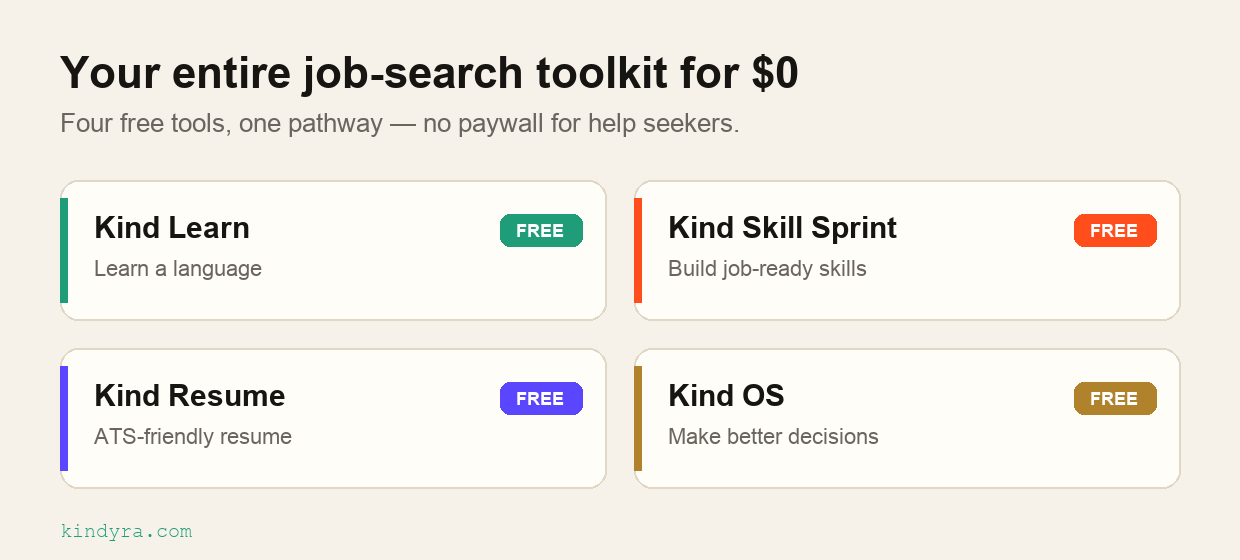
A free stack that fits together
The advantage of tools built as one family is that they follow one path — decide, learn, build proof, present — instead of leaving you to stitch together five disconnected apps:
- Decide — Kindyra OS (early access, opens 2027) — join the early-access list now.
- Learn — KindLearn — free AI-guided daily language lessons.
- Build proof — Kindyra Skill Sprint — 30-day sprints that turn practice into proof; free to start, no credit card required.
- Present — Kindyra Resume — a free, ATS-friendly resume builder with PDF export.
One path, four steps — three free today, the fourth opening in 2027.
How to run it in practice
Give yourself 30–45 minutes a day. Spend the first stretch learning, the middle building one project, and the last week turning it all into a resume and applying. The point isn't the tools — it's the habit they support.
Here is the same month laid out week by week. The minutes are a suggestion, not a rule. What matters is the last column: each week should end with something you can point at.
| Week | Tool | Daily minutes | Tangible output by the end of the week |
|---|---|---|---|
| Week 1 — Decide | The free career quiz on this site, plus a notebook. (Kindyra OS, the decision tool, is early access and opens in 2027.) | 30–45 | One written target: the role you are aiming at, the one skill it clearly needs, and the kind of proof employers in that field respect. |
| Week 2 — Learn | Kindyra Skill Sprint for a job skill — or KindLearn if the skill is a language. | 30–45 | Seven days of finished daily exercises and your first small piece of real work, all saved in one folder. |
| Week 3 — Build proof | Kindyra Skill Sprint, continued — this week the goal is the finished project. | 30–45 | One small, finished project plus a half-page write-up: the problem, what you did, the result, what you would improve. |
| Week 4 — Present | Kindyra Resume and its ATS resume checker. | 30–45 | One ATS-friendly resume PDF that leads with the new skill and the project, tailored to one real posting — and your first small batch of targeted applications sent. |
If the skill you chose is bigger than three weeks, don't stretch the plan — shrink the project. A finished small thing with a write-up is worth more in an application than an ambitious half-built one.
What these tools do not do
Honesty cuts both ways, so here is the other side. None of these tools applies for jobs on your behalf, and none of them can promise you an interview, a job or an income — nobody can. KindLearn is designed for short daily practice that builds everyday conversation basics over weeks; it will not make you fluent in a month. A skill sprint is designed to take about 30 days at 30–45 minutes a day — enough time to learn one skill and finish one small project you can show — not to make you a senior professional. Kindyra Resume helps you build and check a resume, but it cannot invent experience you do not have, and it should not: recruiters check. And Kindyra OS, the decision step, is not open yet — it is early access and opens in 2027, which is why week 1 above uses the career quiz and a notebook instead. What the stack does is remove the cost barrier and give you a path. The work — showing up daily, finishing the project, sending the applications — is still yours.
Free doesn't mean lower quality
Being free is a mission choice, not a quality compromise. The best thing a free tool can do is remove the excuse to not start. Everything after that is just showing up.
Frequently asked questions
Is a free resume builder good enough?
Yes, if it outputs clean, ATS-friendly formatting and lets you export without a watermark. A free builder can produce a clean, ATS-readable resume.
What career tools are actually free with no paywall?
KindLearn is free, Kindyra Skill Sprint is free to start with no credit card required, and Kindyra Resume is a free AI resume builder — no paywall on the core result, by design of the Kindness Community Foundation. Kindyra OS is early access and opens in 2027; you can join the early-access list now.
Do I need to pay to get job-ready?
No. Learning, skill-building, and a solid resume can all be done with free tools. Consistency matters far more than spending money.