
- A second language helps most in client-facing, healthcare, international and relocation roles.
- You don't need fluency — practical, conversational ability already signals a lot.
- Consistency beats intensity: about 15 focused minutes a day.
A second language isn't a magic hiring key — but in client-facing roles, international teams, healthcare, education, and relocation, it's a practical advantage. The question isn't "is it useful?" so much as "useful for what?"
When a second language genuinely helps
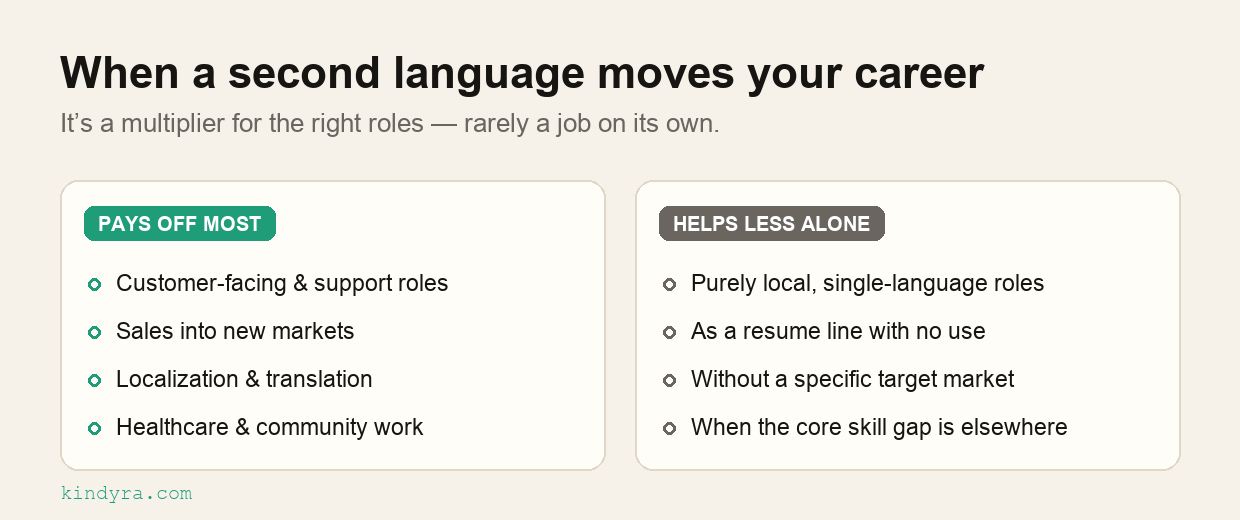
Language skills pay off most clearly when the job actually uses them. The strongest cases:
- Client-facing and sales roles serving multilingual customers.
- Healthcare and education, where communicating with families directly builds trust.
- International or remote teams where a shared language smooths collaboration.
- Relocation — even conversational ability changes how you're received.
In these settings, a language isn't a "nice to have" line on your resume — it's part of doing the job well.
When it matters less (be honest with yourself)
If you're targeting a role that's fully monolingual and local, a second language is a lovely personal achievement but rarely the deciding factor in hiring. That's okay — just don't expect it to substitute for the core skills the job needs. Pair it with real, job-ready abilities.
How much do you actually need?
You do not need fluency to benefit. Conversational, practical ability — enough to greet, explain, and handle common situations — already signals effort, cultural respect, and adaptability. Employers notice the trajectory, not just the certificate.
That reframes the goal: instead of "become fluent," aim for "become genuinely useful in everyday situations." That's achievable with steady daily practice.
What reliably works: small and daily
Every honest guide lands in the same place — consistency beats intensity. Fifteen minutes a day for a month will take you further than one long weekend of cramming. Streaks, spaced repetition, and a little gamification are there to help you keep going — they make showing up easier.
KindLearn's free, AI-guided daily lessons make this realistic — no subscription pressure, no all-or-nothing plan. You practice a little, every day, and let it compound. Our guide on how to learn a language covers the daily routine in more depth.
Putting it on your resume
List the language with an honest proficiency level (e.g. "Conversational Spanish"). Don't inflate it — a five-minute interview switch to that language will expose an exaggeration fast. Honest and improving beats fluent-on-paper.
Which level to write: CEFR levels in plain English
The clearest way to state a level is the CEFR — the Common European Framework of Reference for Languages, a six-step scale from A1 (beginner) to C2 (near-native). Writing "CEFR B1" tells a recruiter more than "intermediate" does, because the levels are defined the same way everywhere. The plain meanings and resume wording below are ours; the quoted lines are from the official CEFR self-assessment grid as published on Europass, the European Union's site for CVs and skills. We quote the first sentence of the listening descriptor for each level; the full grid also covers reading, speaking and writing.
| Level | Plain meaning | Official descriptor (listening, first sentence) | Resume wording |
|---|---|---|---|
| A1 | Absolute beginner. Greetings, numbers, a few set phrases. | "I can recognize familiar words and very basic phrases concerning myself, my family and immediate concrete surroundings when people speak slowly and clearly." | Spanish — beginner (CEFR A1), studying daily |
| A2 | Basic. Simple everyday exchanges — shopping, directions, your job in a sentence. | "I can understand phrases and the highest frequency vocabulary related to areas of most immediate personal relevance (e.g. very basic personal and family information, shopping, local area, employment)." | Spanish — elementary (CEFR A2) |
| B1 | Conversational. You can handle most everyday situations and talk about familiar work topics. | "I can understand the main points of clear standard speech on familiar matters regularly encountered in work, school, leisure, etc." | Spanish — conversational (CEFR B1) |
| B2 | Working proficiency. You can do a job in the language — follow meetings, argue a point, write a clear email. | "I can understand extended speech and lectures and follow even complex lines of argument provided the topic is reasonably familiar." | Spanish — professional working proficiency (CEFR B2) |
| C1 | Advanced. Fluent and precise, including nuance and long, loosely structured speech. | "I can understand extended speech even when it is not clearly structured and when relationships are only implied and not signalled explicitly." | Spanish — advanced, fluent (CEFR C1) |
| C2 | Mastery. Near-native in any setting, at any speed. | "I have no difficulty in understanding any kind of spoken language, whether live or broadcast, even when delivered at fast native speed, provided I have some time to get familiar with the accent." | Spanish — near-native (CEFR C2), or simply "Native" |
Two honest rules. First, if you have not sat an official exam, say so — "CEFR B1 (self-assessed)" is honest and still useful, and the Europass grid above is written for exactly that kind of self-check. Second, put the language where the job will use it: near the top under Skills for a client-facing or relocation role, last for a fully local one. One line per language is plenty, and it belongs in the clean single-column layout an ATS-friendly resume needs.
Not at the level you want yet? Every step up the scale is reached the same way — steady daily practice, not cramming. Our guide on how to learn a language and stick with it lays out the routine, and KindLearn is free.
Frequently asked questions
Which language should I learn for my career?
The one your target employers, customers, or region actually use. Don't chase the "most popular" language — chase the one that fits where you want to work.
Do I need to be fluent to put a language on my resume?
No. List an honest level like beginner or conversational. Employers value visible effort and steady progress; just don't overstate it.
How long until a language is useful?
KindLearn is designed for short daily practice that builds everyday conversation basics over weeks — the aim is to be useful long before fluency.